AI Video Generator: kiss & Hug
- 3.5
- Rating
- 1.00M
- Installs
- Free
- Price
 Analysis by App-foxy
I tried AI Video Generator: kiss & Hug as a quick way to turn ordinary photos into playful AI clips, and my first impression was that it aims for instant results rather than detailed editing. It sits in the Art & Design category, comes from Hangover Studios, and is free to install, although some of the more advanced creative options are connected to in-app purchases ranging from $2.49 to $59.99 per item. That combination makes it easy to test, but it also means you should approach it as a casual creative tool instead of a complete video-production studio.
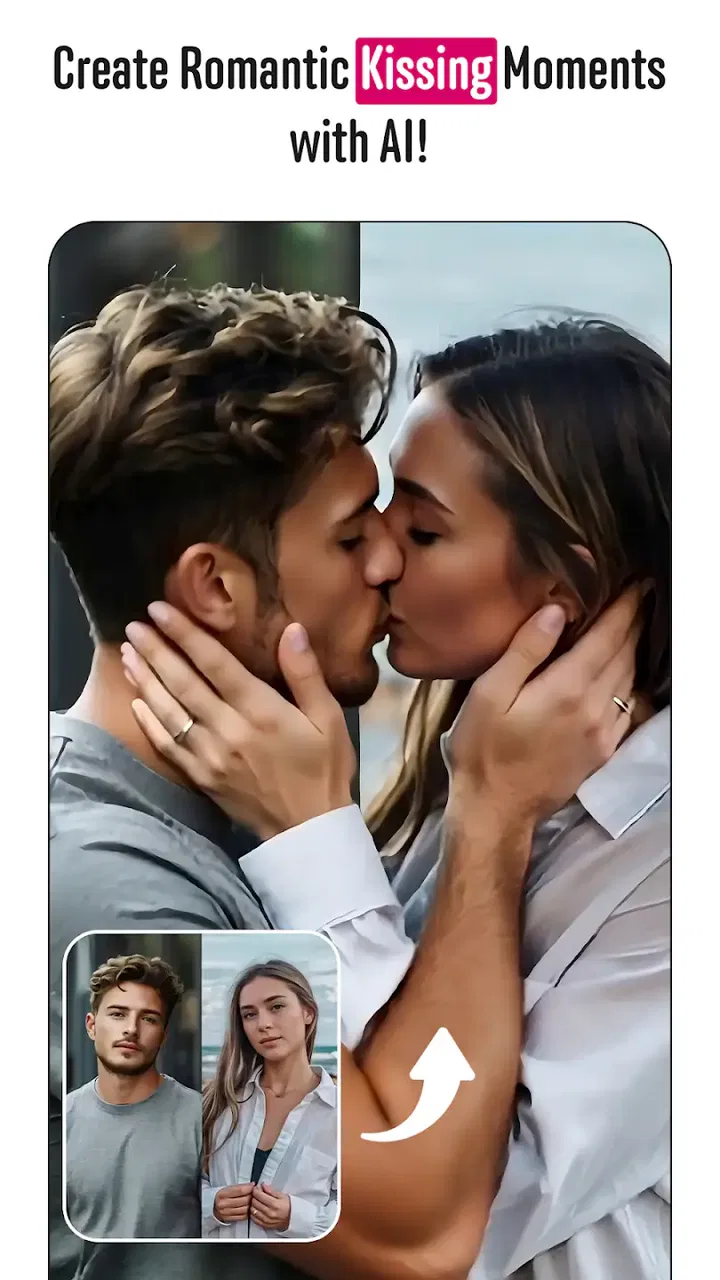
The app’s main appeal is simple: you start with an image, choose an effect or transformation, and let the generator create a short visual result. The focus is on AI-driven clips involving affectionate gestures, face changes, anime-inspired edits, and magical effects. I found that concept more useful for social posts, jokes among friends, and quick experiments than for polished storytelling. If you enjoy seeing how one image can be reinterpreted in several styles, there is enough variety to keep the first sessions interesting.
Its public reception is mixed rather than universally enthusiastic. The app has an average rating of 3.6 from around 3,200 ratings and has passed one million installs, so it clearly attracts a substantial audience while still leaving room for criticism. I think that balance is important: the novelty is real, but AI video generation can be inconsistent, and the result is not always as natural or controllable as the preview idea suggests.
You May Also Like

 Blood Strike: 2.5 Anniversary
Blood Strike’s Loadouts Turn Every Drop Into a Tactical Gamble
A close look at Blood Strike’s custom loadouts: how fast access to signature weapons reshapes its battle royale rhythm, rewards preparation, and narrows the gap between fights.

 Pandora - Music & Podcasts
Pandora’s Music Is Easy to Start, but Harder to Recover
Pandora’s strength is its low-effort path from a seed to a station. Its weak spot is how much confidence it asks you to place in connection, setup, and quiet recovery.

 8 Ball Pool
 Is Built on Rivalries, Rematches, and Routine
A close look at the rivalries, rematches, shared routines, and unanswered safety questions that turn a quick pool match into a persistent mobile community.

 Samsung Music
’s Quiet Strength Is Playing What You Already Own
Its reach comes less from spectacle than from dependable access to a personal library. That simplicity is both the app’s strongest retention engine and its ceiling.

 AccuWeather: Weather Radar
AccuWeather Review: A Quick, Clear Forecast for Everyday Decisions
For everyday plans, the best forecast is the one you can understand quickly. AccuWeather makes rain timing, radar, and local conditions easy to act on, with a few trade-offs.

 Hill Climb Racing
Why Hill Climb Racing Still Turns Crashes Into One More Run
A tiny car, a bumpy hill and one more upgrade: Hill Climb Racing keeps resurfacing because its simple chaos makes every near-miss feel personal.
More From Our News Desk



How the app feels in everyday use
I find this app easiest to judge when I imagine it being used on a shared phone: one person picks a portrait, another suggests an effect, and everyone decides together whether the result is funny enough to keep. That can make a quick creative break, but it also makes clear why image choice and consent should be agreed on before anyone starts. Next, I’d think about simple boundaries for whose photos are used and where the clips go.
A fast workflow built around one visual idea
The most comfortable way to use the app is to begin with a clear, uncomplicated photo. A well-lit portrait with one obvious subject gives the generator less visual clutter to interpret. When I used the app with a busy background or several people positioned close together, the creative effect had more opportunities to look awkward. That is not unusual for this type of tool, but it affects how much time you spend choosing the source image before you even begin.
I would describe the workflow as playful rather than precise. You are not opening a traditional timeline where every movement, cut, and transition can be adjusted manually. Instead, you are choosing an AI treatment and judging the generated result. This makes the app approachable for someone who has never edited a video, while it can feel limiting to anyone who wants frame-by-frame control.
A realistic everyday use would be making a birthday message for a friend. You could select a friendly portrait, try a hug-style effect, and share the resulting clip in a private chat or social post. The time-saving benefit is obvious: you do not need to film both people together or learn a conventional editing program. The trade-off is that the final animation may feel more like a fun digital card than a believable recording of a real moment.
Choosing photos matters more than most beginners expect
One of the less obvious lessons is that the input image often determines whether the result feels charming or strange. Faces turned too far away, hands covering important features, sunglasses, heavy shadows, and cropped heads can all make an AI transformation less convincing. I recommend preparing a small set of alternatives instead of repeatedly forcing one unsuitable photo through every effect.
For face-oriented edits, a front-facing image with visible eyes and a relaxed expression is usually the safest starting point. For anime or magical treatments, a more expressive pose can be interesting, but extreme gestures may also produce distorted details. The practical trick is to test the simplest portrait first, then move toward more dramatic images once you understand how the chosen effect behaves.
This also answers a question many new users have: can any photo work equally well? In my experience, no. The app is easy to operate, but the quality depends heavily on the source material. Treating image selection as part of the creative process produces better results than assuming the generator will repair every weak photo.
Where the kiss and hug concepts work best
The affectionate effects are clearly designed for lighthearted personal content. They can work nicely when the people in the source images are close friends, partners, or family members who understand the joke. I would be more careful with coworkers, acquaintances, or anyone whose image you do not have permission to use. A generated clip can look playful to one person and uncomfortable or misleading to another.
There is also an important difference between a private joke and a public upload. Before sharing a result, I would ask whether everyone shown would be comfortable with the transformation and whether the clip could be mistaken for a real event. The app makes creation quick, but responsible sharing still requires a human decision. That is especially relevant because the content rating is Teen, which signals that the app is not aimed at very young children.
When the source images already show warmth or affection, the effect feels more natural. When the people have neutral expressions or very different lighting, the generated interaction can look artificial. I see that as a creative limitation rather than a reason to reject the feature, but it is worth knowing before you promise someone a polished result.
Anime edits and magic effects offer a different kind of value
The anime and fantasy-oriented options are more forgiving than realistic face interactions because stylization gives visual errors a different context. A slightly unusual facial detail may look like part of an illustrated transformation instead of an obvious mistake. For profile content, mood boards, themed invitations, or a quick visual experiment, this can be more satisfying than trying to imitate real footage.
I especially like the idea of using a short generated clip as a starting point rather than a finished production. For example, an artist could use a stylized portrait to explore a color mood before creating a more carefully designed illustration. A small business owner might use a magical visual as a draft for a social campaign concept, then recreate the strongest idea with proper branding and manual editing.
However, I would not rely on the app for precise brand work. If your design needs exact typography, consistent character details, repeatable colors, or a carefully controlled sequence, a conventional editor or a dedicated design application is a better choice. AI Video Generator: kiss & Hug is strongest when surprise and speed matter more than exact repetition.
What the current version tells existing users
The current version is 75.0.0, and the app was released on July 22, 2024. Those details suggest a product that has already moved through a substantial cycle of updates rather than remaining at its first launch build. I would read that as evidence of ongoing development, but not as proof that every rough edge has disappeared. A version number by itself cannot tell me whether a particular effect is more stable, whether generation is faster, or whether the interface changed in a way every user will appreciate.
For someone already using an earlier build, the sensible approach is to judge the update through practical results: whether favorite effects remain available, whether familiar projects still open correctly, and whether the generation flow feels clearer. I would also avoid assuming that a newer version automatically means more consistent output. AI tools can evolve unevenly, with one style improving while another still produces unpredictable faces, hands, or movement.
New users benefit from starting with modest expectations. The app’s current state is best understood as an accessible experimenter for AI video effects. It is not a replacement for a full editor, and the version information does not change that basic identity. What it does offer is a low barrier to trying several visual ideas without first learning a complicated production workflow.
How it compares with ordinary alternatives
Compared with a standard mobile video editor, this app removes much of the manual work. A conventional editor gives you dependable control over trimming, captions, music, transitions, and timing, but you must supply the creative decisions yourself. Here, the generator supplies the transformation, which is much faster when your goal is a surprising visual from a single image.
That convenience comes with less predictability. In a regular editor, a portrait stays the same portrait unless you deliberately alter it. In an AI effect app, the system may reinterpret facial features, body position, or the relationship between subjects. For a joke or experimental post, that unpredictability can be the point. For a client presentation, memorial video, tutorial, or important announcement, I would choose the conventional editor.
It also differs from a dedicated image-generation application. Image tools are often better suited to making a single carefully composed still, while this app’s identity is tied to movement and short-form visual transformation. If your goal is a poster, logo, detailed illustration, or a series of consistent images, another art application will probably give you more control. If your goal is to animate a personal photo quickly, this app is more directly relevant.
Costs, expectations, and the free starting point
The free entry point is useful because you can discover whether the style suits you before spending anything. I recommend using that opportunity to test several source photos and compare realistic effects with the more stylized options. Do not judge the whole app from one disappointing generation; the input image and selected treatment can make a major difference.
At the same time, the in-app purchase range is broad, so it is worth paying attention to what you are selecting before confirming a purchase. I would only consider paying after identifying a repeatable use case, such as making regular social content or preparing a series of themed clips. Spending simply because one result looks amusing can become poor value if later generations do not match it.
The app is better suited to occasional creators than to someone who needs a predictable monthly production pipeline. A person making a few playful clips for friends may find the free access enough. Someone producing frequent commercial content should compare the total cost and consistency with a full editing workflow before committing to paid options.
Privacy, consent, and sharing deserve attention
Because the app works with personal images, I would make consent part of the workflow, not an afterthought. Do not upload a friend’s face for a romantic or embarrassing transformation just because the result seems funny. Ask first, especially when the finished clip could be shared outside a private conversation.
I would also keep a clear separation between harmless experimentation and deceptive presentation. A generated hug or kiss can be obviously artificial in one context and misleading in another. If a clip is posted publicly, a short note that it is AI-generated can prevent confusion. This is not a technical feature of the app; it is simply good practice when working with recognizable people.
For family use, the Teen rating is another reason for supervision and sensible boundaries. The app can be entertaining, but younger users may not fully understand why using another person’s likeness without permission can cause problems. I would introduce it as a creative tool with rules about consent, private images, and public sharing.
Who will enjoy it, and who should skip it?
I would recommend it to curious users who want quick AI video experiments, social-media creators who enjoy testing visual hooks, and friends looking for a playful way to transform portraits. It is also appealing to beginners who feel intimidated by a traditional timeline editor. The instant, effect-led approach lets you explore an idea before deciding whether it deserves more serious work.
I would skip it if you need exact control over every frame, professional color management, reliable character continuity, or a polished export workflow built around client approval. It is also not the right choice for using other people’s faces casually without their agreement. In those situations, a manual editor or a more controlled design tool is safer and more appropriate.
My most useful workflow is to create several variations from carefully chosen images, keep only the strongest concept, and then finish the result in a conventional editor if it needs captions, trimming, or a specific posting format. That two-step process avoids asking the AI generator to handle jobs it was not designed to do while preserving its strongest advantage: rapid visual experimentation.
What I would watch as the app develops
The next meaningful improvements would be consistency, control, and clearer handling of personal media. I would like to see effects preserve identity more reliably while still allowing expressive movement. Better repeatability would matter especially to creators who want to build a recognizable series instead of producing one-off surprises.
I would also watch how the current version develops for existing users. A useful update should make it easier to understand which effect fits a particular photo, reduce wasted attempts, and keep the creative process transparent. More options are not automatically better if they make it harder to tell what each choice will do.
For now, I see AI Video Generator: kiss & Hug as a fun, accessible experiment rather than a finished replacement for mobile editing software. Its best moments come when I give it a suitable portrait, accept a little unpredictability, and use the result for a casual purpose. Its weak moments appear when I expect realism, precision, or professional consistency.
My final recommendation is to install it if you are curious about turning photos into animated jokes, affectionate greetings, anime-style clips, or fantasy edits. Start free, use simple images, and treat each generation as a draft rather than a guaranteed final. With those expectations, the app can be genuinely entertaining and occasionally useful. If your priority is control over the final video, I would spend my time with a traditional editor instead.
FAQs for AI Video Generator: kiss & Hug
01What is AI Video Generator: Kiss & Hug?
AI Video Generator: Kiss & Hug is an image-to-video application designed to create short, romantic animations from still photos. After selecting a suitable picture, the app uses artificial intelligence to simulate affectionate movements, such as hugging or kissing. Results can vary depending on image quality, facial positioning, lighting, and the selected effect, so it is best viewed as an entertainment and creative tool rather than a professional video editor.
02How do I create a Kiss or Hug video with the app?
To create a video, you generally need to import an image from your device or choose one through the app’s upload screen, then select the desired Kiss or Hug animation. The service processes the image and generates a short clip, which may take some time depending on your connection and current server demand. For better results, use a clear, front-facing photo with visible faces and minimal obstructions.
03Is AI Video Generator: Kiss & Hug free to use?
The application may offer limited access to its features for free, while additional generations, faster processing, premium effects, or watermark removal can require payment. Availability and pricing may differ between Android and iOS and can change through updates. Before confirming a purchase or subscription, carefully review the in-app pricing, renewal terms, trial conditions, and cancellation instructions shown in your store account.
04Are my photos and generated videos private?
Because the app needs to analyze uploaded images to create an AI animation, photos may be transferred to remote servers for processing. Users should read the current privacy policy to understand how images, generated clips, account details, and technical data are stored, used, or deleted. Avoid uploading sensitive photographs, and only use images of other people when you have their permission.
05What kind of photos produce the best results?
The most reliable results usually come from high-resolution photos showing one or two people clearly, with faces looking toward the camera and no sunglasses, masks, heavy shadows, or objects covering important features. Similar lighting and a simple background can also help the animation appear more natural. Group photos, side profiles, blurry images, or pictures with dramatic poses may produce distorted faces or unexpected movements.
Pros
- Creates affectionate kiss and hug videos from simple photos.
- Easy interface suitable for users without video-editing experience.
- Generates shareable clips quickly for social media and messaging apps.
- Useful for creating personalized greetings and romantic surprises.
- Works well for experimenting with playful AI-generated scenarios.
Cons
- Results can vary noticeably depending on photo quality and facial visibility.
- Some generated movements may look unnatural or slightly distorted.
- Privacy concerns may arise when uploading personal or intimate photos.
- Advanced effects or unlimited generations may require a paid plan.
- The app may not accurately preserve every person’s appearance in videos.

AI Video Generator: kiss & Hug
Gallery